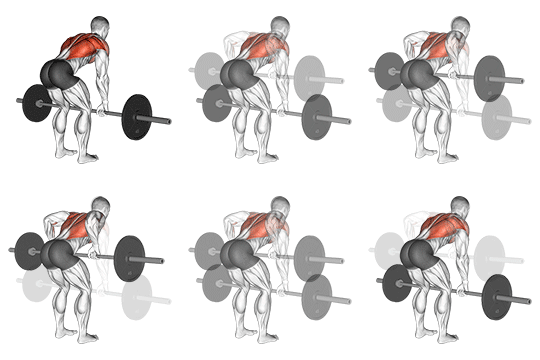
How to Do the Barbell Pendlay Row
Intermediate back exercise with barbell.
The Barbell Pendlay Row is an intermediate-level back exercise that works several muscles together, led by the mid back, using barbell. As a compound movement it lets you handle heavier loads and trains coordination across multiple joints, which makes it a strong anchor for a training day. It slots into most gym setups, and SSS Workout Assistant will program it automatically when it fits your goal and available equipment.

Exercise details
- Muscle group
- Back
- Primary muscle
- Mid Back
- Equipment
- Barbell
- Difficulty
- Intermediate
- Type
- Compound
How to perform it
- 1Stand with your feet shoulder-width apart and your knees slightly bent.
- 2Bend forward at the hips, keeping your back straight and your chest up.
- 3Grasp the barbell with an overhand grip, slightly wider than shoulder-width apart.
- 4Pull the barbell towards your upper abdomen, squeezing your shoulder blades together.
- 5Lower the barbell back down to the starting position.
- 6Repeat for the desired number of repetitions.
How to program the Barbell Pendlay Row
- Do the Barbell Pendlay Row early in your session while you're fresh — compound lifts deserve your best energy.
- Warm up with one or two lighter sets before your working sets to prime the movement.
- As a compound lift, 3–5 sets of 5–8 reps builds strength, while 3–4 sets of 8–12 reps favours muscle growth. Rest 90–180 seconds between sets so you can move quality load.
- To progress, add a small amount of load only after you can hit the top of your rep range with clean form.
Barbell Pendlay Row alternatives
No barbell? These train the same mid back, grouped by what you have available.
No equipment
Dumbbell or kettlebell
Easier and harder variations
The Barbell Pendlay Row is rated intermediate. Regress while you build the pattern, progress once it feels easy.
What to pair it with
For a balanced session, pair the Barbell Pendlay Row with a move for the opposing muscles — the Barbell Bench Press - Medium Grip (chest) or the Barbell Decline Bench Press (chest). Alternating the two as a superset saves time, because one side rests while the other works.
Where it fits in your weekly plan
When the free routine generator builds your week, the Barbell Pendlay Row can land on:
- Full Body days — in 1–2 days a week plans
- Pull days — in 3, 5 or 6 days a week plans
- Upper Body days — in 4 or 5 days a week plans
Included when your equipment is set to: Full gym.
Free tools for this exercise
Put it in your plan
SSS Workout Assistant builds a custom weekly routine around your goals and adds moves like the Barbell Pendlay Row automatically — then tracks every set.
Build my free planFrequently asked questions
What muscles does the Barbell Pendlay Row work?
The Barbell Pendlay Row primarily targets the mid back within the back muscle group, and recruits several supporting muscles as a compound movement.
What equipment do I need for the Barbell Pendlay Row?
You need barbell to perform the Barbell Pendlay Row.
Is the Barbell Pendlay Row a compound or isolation exercise?
The Barbell Pendlay Row is a compound exercise, working multiple joints and muscle groups at once. It's well suited to intermediate trainees.
How many sets and reps of the Barbell Pendlay Row should I do?
As a compound lift, 3–5 sets of 5–8 reps builds strength, while 3–4 sets of 8–12 reps favours muscle growth. Rest 90–180 seconds between sets so you can move quality load.
Is the Barbell Pendlay Row good for beginners?
The Barbell Pendlay Row is rated intermediate. Beginners can work toward it by mastering easier variations first and prioritising form over load before adding weight or reps.
What can I do instead of the Barbell Pendlay Row?
Good substitutes that train the same mid back include the Inverted Row (bodyweight), the Bent Over Two-Dumbbell Row (dumbbell), the One-Arm Dumbbell Row (dumbbell). Pick the one that matches the equipment you have.
Can I do the Barbell Pendlay Row at home?
It's usually done in a gym because it needs barbell. At home, substitute a dumbbell or bodyweight variation that trains the same back.