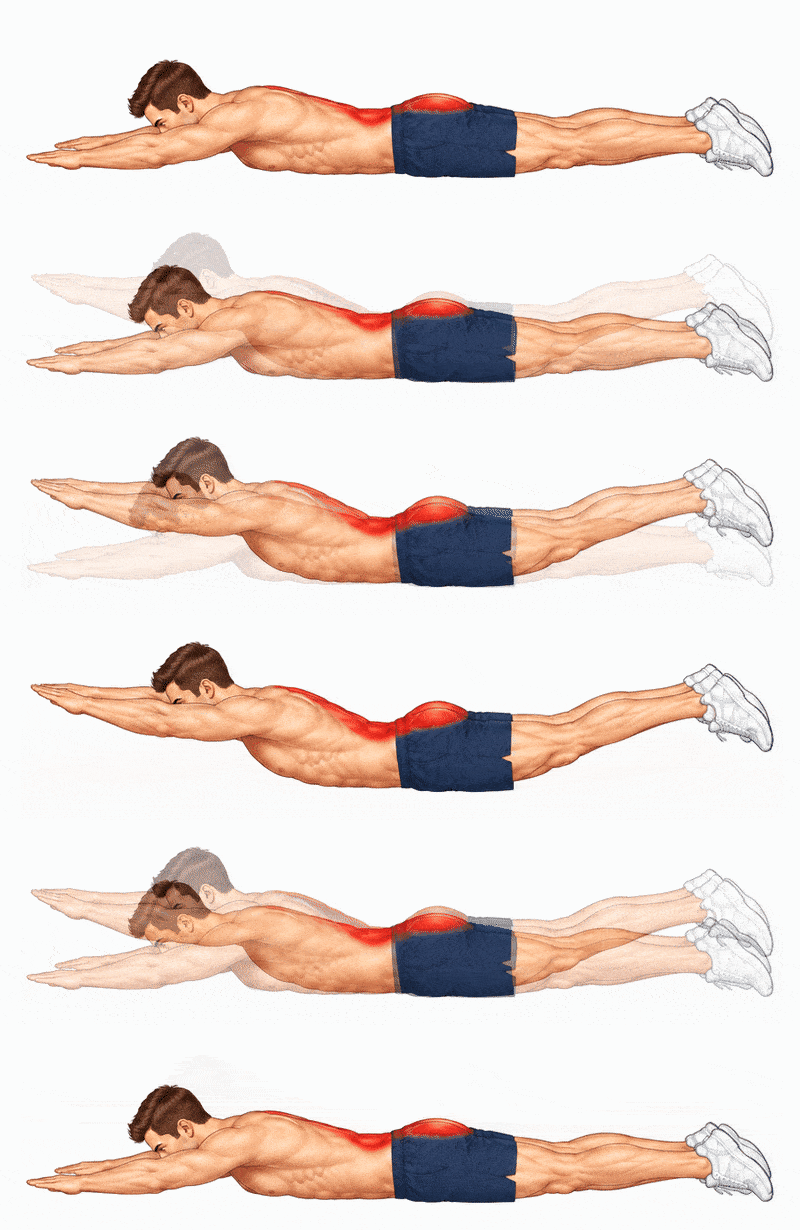
How to Do the Hyperextension (Back Extension)
Beginner back exercise — bodyweight.
The Hyperextension (Back Extension) is a beginner-level back exercise that puts focused tension on the lower back, using no equipment. As an isolation movement it lets you target the lower back directly with less full-body fatigue, so it pairs well as an accessory after your main lifts. You can do it at home or while travelling — no gym required — which makes it easy to keep in your routine consistently.

Exercise details
- Muscle group
- Back
- Primary muscle
- Lower Back
- Equipment
- Bodyweight
- Difficulty
- Beginner
- Type
- Isolation
How to perform it
- 1Adjust the hyperextension bench so that your upper thighs are resting on the pad and your feet are secured.
- 2Cross your arms over your chest or place your hands behind your head.
- 3Lower your upper body towards the ground while keeping your back straight.
- 4Pause for a moment at the bottom, then raise your upper body back up until it is in line with your legs.
- 5Repeat for the desired number of repetitions.
How to program the Hyperextension (Back Extension)
- Use the Hyperextension (Back Extension) later in your workout as an accessory, after your main compound lifts.
- Warm up with one or two lighter sets before your working sets to prime the movement.
- As an isolation move, 3–4 sets of 10–15 reps works well, resting 45–75 seconds. Chase a strong contraction and controlled tempo over heavy weight.
- To progress, add reps, slow the lowering phase, or move to a harder variation once the current version feels easy.
Hyperextension (Back Extension) alternatives
No space? These train the same lower back, grouped by what you have available.
No equipment
Easier and harder variations
The Hyperextension (Back Extension) is rated beginner. Regress while you build the pattern, progress once it feels easy.
Harder — progress from it
What to pair it with
For a balanced session, pair the Hyperextension (Back Extension) with a move for the opposing muscles — the Captains Chair Straight Leg Raise (abs) or the Crunches (abs). Alternating the two as a superset saves time, because one side rests while the other works.
Where it fits in your weekly plan
When the free routine generator builds your week, the Hyperextension (Back Extension) can land on:
- Full Body days — in 1–2 days a week plans
- Pull days — in 3, 5 or 6 days a week plans
- Upper Body days — in 4 or 5 days a week plans
Included when your equipment is set to: No equipment, Dumbbells, Full gym.
Free tools for this exercise
Put it in your plan
SSS Workout Assistant builds a custom weekly routine around your goals and adds moves like the Hyperextension (Back Extension) automatically — then tracks every set.
Build my free planFrequently asked questions
What muscles does the Hyperextension (Back Extension) work?
The Hyperextension (Back Extension) primarily targets the lower back within the back muscle group.
What equipment do I need for the Hyperextension (Back Extension)?
None — the Hyperextension (Back Extension) is a bodyweight exercise you can do anywhere, no gym required.
Is the Hyperextension (Back Extension) a compound or isolation exercise?
The Hyperextension (Back Extension) is an isolation exercise, focusing work on a single muscle group. It's well suited to beginner trainees.
How many sets and reps of the Hyperextension (Back Extension) should I do?
As an isolation move, 3–4 sets of 10–15 reps works well, resting 45–75 seconds. Chase a strong contraction and controlled tempo over heavy weight.
Is the Hyperextension (Back Extension) good for beginners?
Yes — the Hyperextension (Back Extension) is beginner-friendly. Start light, focus on clean technique, and add difficulty gradually as it becomes comfortable.
What can I do instead of the Hyperextension (Back Extension)?
Good substitutes that train the same lower back include the Superman (bodyweight), the Barbell Deadlift (barbell), the Barbell Rack Pull (barbell). Pick the one that matches the equipment you have.
Can I do the Hyperextension (Back Extension) at home?
Yes — it needs no equipment, so it works at home, in a hotel room, or anywhere you have a bit of space.