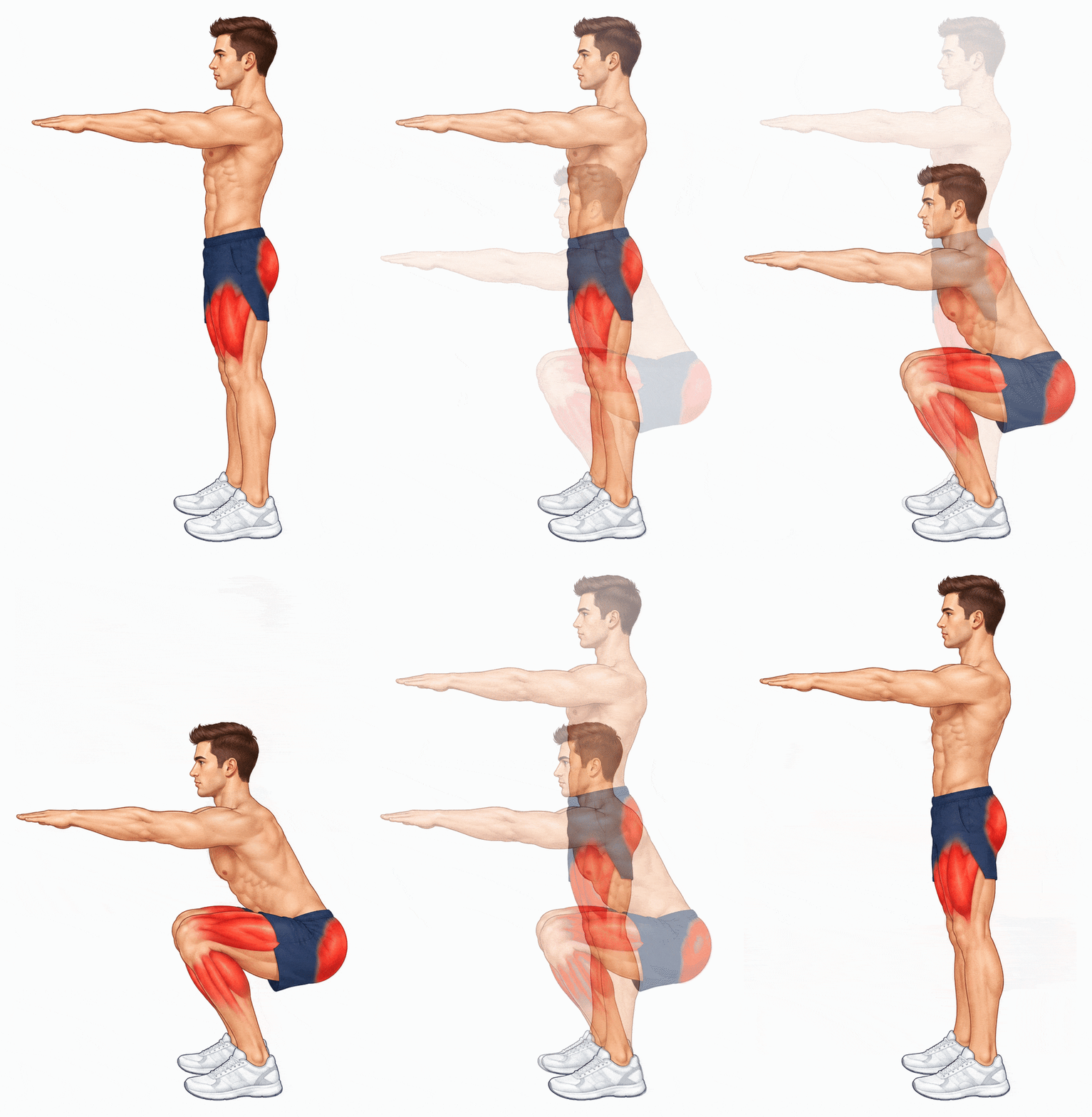
How to Do the Seated Straight-Leg Raise
Beginner legs exercise — bodyweight.
The seated straight-leg raise is a bodyweight exercise where you sit tall with your legs out in front of you and lift them off the floor or bench with straight knees. It trains the quadriceps — especially the rectus femoris, the quad muscle that also lifts the hip — along with the hip flexors and the core holding you upright. With no knee bending it's a low-stress way to build quad and hip-flexor strength, and lifting even a few centimetres is harder than it looks.

Exercise details
- Muscle group
- Legs
- Primary muscle
- Quadriceps
- Equipment
- Bodyweight
- Difficulty
- Beginner
- Type
- Isolation
How to perform it
- 1Sit on a flat bench (or on the floor) with your legs extended in front of you and your torso upright.
- 2Place your hands beside your hips for support, keeping your back straight and braced by your arms.
- 3Keeping both legs straight with the knees locked, slowly raise them together in front of you until they are roughly parallel to the ground.
- 4Pause for a moment at the top, then lower your legs back down under control to the starting position.
- 5Repeat for the required number of repetitions.
- 6A gentle quad and hip-flexor isolation movement, well suited to beginners and knee-friendly conditioning.
Seated Straight-Leg Raise form cues
- Sit tall with your hands just behind your hips — use them for balance, not to lean back.
- Tighten your thigh muscles first so your kneecaps lift, then raise your legs.
- Point your toes up toward the ceiling and keep your knees straight through the whole rep.
- Hold the top for one to two seconds before lowering slowly.
Common Seated Straight-Leg Raise mistakes
Leaning far back to get the legs higher
Leaning back turns it into an ab exercise. Stay upright — a small lift with good posture is the real exercise.
Bending the knees
Bent knees take the quads out. If you can't keep them straight, raise one leg at a time.
Dropping the legs
Lower them over two seconds; the controlled lowering is half the benefit.
Who the Seated Straight-Leg Raise is for
Beginners, people who want quad work without knee bending, and anyone training hip-flexor strength for running, kicking or hanging leg raises. It's also a useful no-equipment move for desk-based routines.
Seated Straight-Leg Raise vs similar exercises
vs Leg Extensions
The leg extension also isolates the quads but bends the knee against load on a machine. The seated straight-leg raise keeps the knee straight and uses bodyweight only.
How to program the Seated Straight-Leg Raise
- Use the Seated Straight-Leg Raise later in your workout as an accessory, after your main compound lifts.
- Warm up with one or two lighter sets before your working sets to prime the movement.
- As an isolation move, 3–4 sets of 10–15 reps works well, resting 45–75 seconds. Chase a strong contraction and controlled tempo over heavy weight.
- To progress, add reps, slow the lowering phase, or move to a harder variation once the current version feels easy.
Seated Straight-Leg Raise alternatives
No space? These train the same quadriceps, grouped by what you have available.
Dumbbell or kettlebell
Machine or cable
Easier and harder variations
The Seated Straight-Leg Raise is rated beginner. Regress while you build the pattern, progress once it feels easy.
Harder — progress from it
What to pair it with
For a balanced session, pair the Seated Straight-Leg Raise with a move for the opposing muscles — the Glute-ham Raise (hamstrings) or the Nordic Hamstring Curl (hamstrings). Alternating the two as a superset saves time, because one side rests while the other works.
Where it fits in your weekly plan
When the free routine generator builds your week, the Seated Straight-Leg Raise can land on:
- Full Body days — in 1–2 days a week plans
- Legs days — in 3, 5 or 6 days a week plans
- Lower Body days — in 4 or 5 days a week plans
Included when your equipment is set to: No equipment, Dumbbells, Full gym.
Free tools for this exercise
Put it in your plan
SSS Workout Assistant builds a custom weekly routine around your goals and adds moves like the Seated Straight-Leg Raise automatically — then tracks every set.
Build my free planFrequently asked questions
Should I do one leg or both legs at once?
Start with one leg at a time if two legs force you to lean back or bend your knees. Move to both legs once single-leg reps feel controlled.
How many reps should I do?
Try 2–3 sets of 10–15 slow reps with a one-second pause at the top. When that's easy, add a longer hold or ankle weights.
What muscles does the Seated Straight-Leg Raise work?
The Seated Straight-Leg Raise primarily targets the quadriceps within the legs muscle group.
What equipment do I need for the Seated Straight-Leg Raise?
None — the Seated Straight-Leg Raise is a bodyweight exercise you can do anywhere, no gym required.
Is the Seated Straight-Leg Raise a compound or isolation exercise?
The Seated Straight-Leg Raise is an isolation exercise, focusing work on a single muscle group. It's well suited to beginner trainees.
How many sets and reps of the Seated Straight-Leg Raise should I do?
As an isolation move, 3–4 sets of 10–15 reps works well, resting 45–75 seconds. Chase a strong contraction and controlled tempo over heavy weight.
Is the Seated Straight-Leg Raise good for beginners?
Yes — the Seated Straight-Leg Raise is beginner-friendly. Start light, focus on clean technique, and add difficulty gradually as it becomes comfortable.
What can I do instead of the Seated Straight-Leg Raise?
Good substitutes that train the same quadriceps include the Sissy Squat (bodyweight), the Wall Sit (bodyweight), the Dumbbell Lunges (dumbbell). Pick the one that matches the equipment you have.
Can I do the Seated Straight-Leg Raise at home?
Yes — it needs no equipment, so it works at home, in a hotel room, or anywhere you have a bit of space.